Updated: Dec. 2, 2024
If you want better ideas more often, happy collisions are the secret.
But before I spell out the cause of happy collisions and how to have more of them, let’s talk about creativity a little. It will help, I promise.
How often do we sit and wonder “Why didn’t I think of that?” How often do we struggle to find solutions to problems that don’t seem that hard?
Creativity flows around us like a raging river. Art, music, television, technology, journalism, philanthropy, on and on and on.
So where do ideas come from?
The most common answers to this question are 1. creative people and 2. random inspiration. Ideas sometimes come from strange places, or at least it seems that way. Or they come from people that are “creatives.”
These assumptions are wrong. Many of our assumptions about where ideas come from are false. And these false assumptions, unfortunately, make creativity less approachable for most people.
Creativity is simply a process.
The more often you repeat that process the better you will get at it.
It is not a gift handed down on high from silver-lined clouds to a magical set of people called “creatives.”
People become more creative when they:
- Are given (or demand) the freedom to be creative
- Commit the time to put in the work
- Develop the core ingredients involved in happy collisions
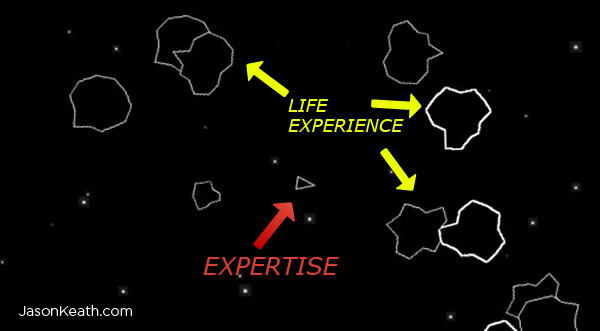
Happy Collisions happen when expertise meets life experience, repeatedly.
If you can generate more of those two ingredients (expertise & life experience), you will generate more big ideas.
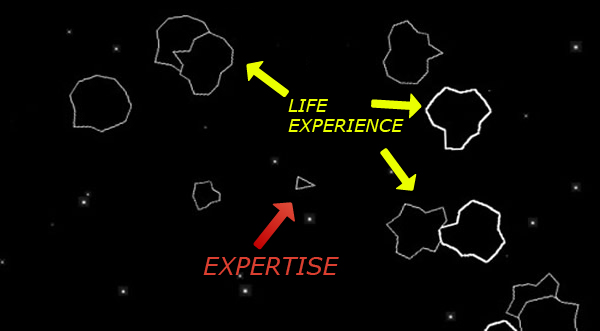
Classic Atari game Asteroids where you pilot a triangle-shaped spaceship, dodging and shooting drifting asteroids.
Ingredient 1: Expertise
The hard work part is something we tend to skip over.
JK Rowling built the world of Harry Potter for 5 years before she started to write the first book. She put in the work to make something great, something new, something creative.
But she was also an expert. She’d been writing stories since she was 5 years old, developing her own fantasy stories and reading them to her younger sister.
That expertise is an important element of creativity. Knowing one subject very well gives you a platform of confidence and problem-solving experience from which new ideas can sprout. And the value of expertise can translate to many other subjects.
But it is only half of the happy collision concept.
Ingredient 2: Life Experience
Friction, when any two objects come into contact and affect or augment one another, creates the opportunity for more ideas. This can result in the acceleration, deformation, or energy transfer of one object. Simply put, friction creates change.
Ideas work the same way. The more ideas we have access to, the more raw material our subconscious has to work with, and the greater the opportunity for friction and for new ideas.
This raw material comes from living life, from learning new things, from new experiences. It sounds simple, but building up your life experiences is one of the most important aspects of encouraging creativity.
Macro Life Experience
We see this in unending studies. People who have lived abroad or who travel a lot, on average, are more creative. People who speak multiple languages are more creative. Even people who live in big cities, where there is more happening, more diversity, stimuli, are more creative.
I’ve personally found public speaking to be a great set of macro life experiences that allow me a high-level creative outlet. Keynote speaking opportunities where I get to share my details expertise on marketing, creativity, and other topics are great for building confidence and critical thinking skills.
All of this raw material is crucial to build up, both on a micro and macro level.
Micro Life Experience
Within our day-to-day lives, we see this same concept. When we are actively focused on a problem, that creative spark can fail to surface. But when we step away from the office or the desk, go out into the world, and let our brain breathe a little, life experience will often show us new solutions to the problems we are trying to solve.
This concept is really on display, if not exaggerated, in books and TV. Sherlock Holmes, Gregory House MD, Don Draper. They all work tirelessly to solve problems, from crimes to diseases to advertising, and they almost always have their big aha moment when they are not actively working on the solution.
Whether it is an innocuous conversation with a stranger or something they read in a newspaper, the insight that closes the story out usually comes from a surprising source. That source is the life experience.
Getting away from focusing on the problem, and upping the raw materials your brain has to bounce ideas off of, gives you a continuous unique source of friction. Upping the chances for inspiration.
You can’t very well move to a new country or learn a new language every time you have writer’s block. But you can get out of the office, read a book, watch an old movie, or take a walk in a different part of town.
“Big ideas come from expertise brushing up against life experience.”
If you’re struggling… If you have writer’s block… If your team is really hitting a roadblock on a brainstorm…
The solution is often to step back, to take a break, to take a walk… Step back and look for opportunities to brush up against life in new ways and more often.
The Happy Collision That Brought Us Velcro
 George de Mestral was walking home from a hunting trip one day in his home country of Switzerland when he noticed the burrs (seeds) that kept sticking to his pants.
Once he was home, he examined the burrs more closely under a microscope and discovered the hundreds of hooks that helped them attach so easily to cloth and fur.
Over the next ten years, he worked to replicate and perfect the effect as a fastener that would become known as Velcro.
That hunting trip that George took was a life experience.
His expertise? George was a talented engineer who created his toy airplane design at age twelve (and patented it). His dad, Albert de Mestral, was an agricultural engineer, specializing in technology used for farming.
Keep working on your expertise. Keep building your life experience. Creativity will follow.